
MILTON, MA - Falls, fractures, bedsores, and medication errors are among the most common injuries in Massachusetts long-term care facilities, and many result from understaffing, inadequate training, or outright neglect that gives rise to legal claims under state and federal law. Boston personal injury attorney Dino M. Colucci of Colucci, Colucci & Marcus, P.C. (https://www.coluccilaw.com/boston-nursing-home-abuse-attorney/injuries/) details the types of preventable injuries that occur in Boston nursing homes and the legal options available to affected families throughout Massachusetts.
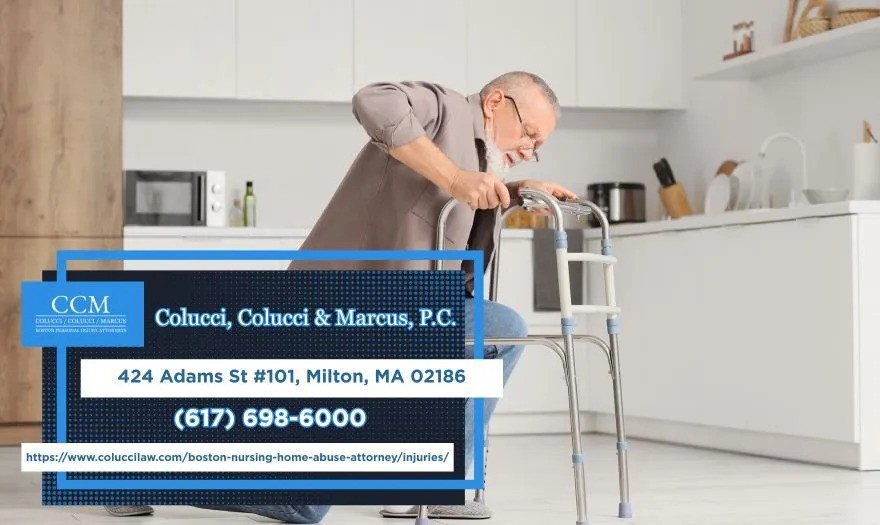
According to Boston personal injury attorney Dino M. Colucci, the Massachusetts Department of Public Health reported that the rate of falls with injury in Massachusetts nursing homes increased nearly 25 percent between 2018 and 2022, climbing from 27.9 to 34.8 falls with injury per 1,000 residents. Among the 14,951 falls with injury reported to the Massachusetts Health Care Facility Reporting System during that period, 81 percent occurred in a resident's own room, and 70 percent occurred during basic activities such as getting out of bed, standing from a chair, or walking. "Even a seemingly minor fall can lead to hip fractures, traumatic brain injuries, or spinal damage in elderly residents, often triggering a cascade of complications including infections and prolonged immobility," explains Colucci.
Boston personal injury attorney Dino M. Colucci highlights that the most serious nursing home injuries extend far beyond the initial harm. Hip fractures are the most serious fall-related injury, often requiring surgery, months of rehabilitation, and leading to a permanent decline in mobility. Residents with dementia face the highest fall risk according to the Department of Public Health and may benefit most from targeted interventions. Pressure ulcers can progress through four stages from surface redness to deep tissue damage exposing muscle and bone, with advanced cases leading to sepsis. Medication errors, including wrong drugs, wrong doses, or missed doses, often result from understaffing and poor record-keeping, and M.G.L. c. 111, Section 72BB requires facilities to obtain informed written consent before administering psychotropic medications.
Attorney Colucci notes that Massachusetts provides multiple layers of legal protection for nursing home residents. M.G.L. c. 111, Section 70E establishes a Patients' Bill of Rights including the right to safe care, informed consent, and freedom from physical and chemical restraints except in documented emergencies. Sections 72F through 72L mandate reporting of abuse, neglect, and mistreatment, and failure to report can itself constitute a violation supporting additional legal action. State licensing standards under 105 CMR 150.000 establish staffing ratios and safety requirements, and M.G.L. c. 93A allows consumer protection claims for unfair or deceptive practices. "Violations of these laws can serve as the foundation for a negligence or abuse claim," Colucci adds.
Most nursing home injuries in Boston trace back to systemic problems within facilities rather than isolated mistakes by individual staff members. Understaffing is the most common cause, with Massachusetts publicly monitoring nursing facility staffing under 101 CMR 206.13. The Department reports that facilities meeting staffing minimums consistently had lower rates of falls with injury than facilities that fell short, yet many facilities continue to operate below minimum levels, particularly during evening and overnight shifts. Inadequate training and failure to follow individualized care plans, including ignoring physician orders regarding medication, repositioning schedules, or assistive devices like bed alarms and wheelchair sensors, also contribute significantly to preventable harm.
Darin Colucci of the firm explains that families whose loved ones have been injured may recover compensation for medical expenses, pain and suffering, wrongful death damages under M.G.L. c. 229, and consumer protection damages under Chapter 93A that may allow treble damages and attorney fees. "When a facility's systemic failures lead to preventable injuries, the institution, not just the individual staff member, can be held accountable under multiple theories of liability," notes Darin Colucci. Massachusetts generally allows three years for personal injury tort claims under M.G.L. c. 260, Section 2A, and the 182-day written notice rule under M.G.L. c. 231, Section 60L may apply to claims against health care providers.
Two exceptions may extend the filing deadline: the discovery rule, which starts the clock when the injured person first learned of the negligence, and fraudulent concealment, where a facility actively hid evidence of neglect. Families are advised to seek immediate independent medical attention for injured residents from a provider outside the nursing home to create a neutral record of injuries, document all observations with photographs and detailed written notes including dates, times, and staff names, file complaints with the Massachusetts Department of Public Health and the Executive Office of Elder Affairs, and request copies of medical records, care plans, medication logs, and incident reports from the facility.
The firm advises families to seek immediate independent medical attention for injured residents, document injuries with photographs and written observations, file complaints with the Massachusetts Department of Public Health and the Executive Office of Elder Affairs, and request copies of medical records, care plans, and incident reports. The firm represents families across Boston and throughout Massachusetts, including Milton, Quincy, Braintree, Dedham, Brookline, Cambridge, Somerville, Newton, Brockton, Plymouth, Fall River, New Bedford, and Worcester.
For those with a loved one who has been injured in a nursing home, prompt consultation with a personal injury attorney can help preserve evidence and protect the family's legal rights within applicable filing deadlines.
About Colucci, Colucci & Marcus, P.C.:
Colucci, Colucci & Marcus, P.C. is a Milton, Massachusetts-based law firm focused on personal injury litigation, including nursing home negligence and wrongful death cases. Led by attorney Dino M. Colucci, who has handled nursing home negligence cases throughout Boston for over 30 years, the firm pursues accountability when facilities fail residents. Attorney Darin Colucci serves as managing partner and has been named among the Top 10 Personal Injury Attorneys by Newsweek Magazine. Attorney Matthew Marcus focuses on elder law and estate planning. For consultations, call (617) 698-6000.
Email: david@coluccilaw.com
Media Contact
Name
Colucci, Colucci & Marcus, P.C.
Contact name
David Colucci
Contact phone
(617) 698-6000
Contact address
424 Adams St #101
City
Milton
State
MA
Zip
02186
Country
United States
Url
https://www.coluccilaw.com/
COMTEX_483096171/2888/2026-06-05T13:22:05